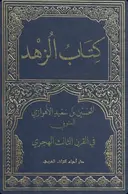
Kitāb al-Zuhd, is penned by the reputable 3rd century Shīʿī scholar and narrator, al-Ḥusayn b. Saʿīd al-Ahwāzī. It is a beautiful work in Islamic literature that examines ethics and character within the context of spiritual self-discipline and asceticism (Zuhd). Focusing on the teachings of the Ahl al-Bayt (as), the book underscores the significance of good character and etiquette as fundamental to the life of a devout Muslim. Comprising nearly three hundred narrations, this text furnishes practical advice to believers aiming to elevate their moral and ethical conduct. The narrations provide insights that transcend temporal bounds, retaining their relevance and applicability to the modern world, and serve as a guide to enhancing a believer's life in both the worldly and spiritual realms. Kitab al-Zuhd offers a valuable wellspring of ethical teachings, guiding believers towards higher stations of moral and spiritual excellence as inspired by the teachings of the Ahl al-Bayt (as).
A könyvek leírása és a hadíthok fordítása angol nyelvű (forrás: Thaqalayn.net). Az arab eredeti minden hadíth mellett szerepel.
Introduction
Translator’s Introduction
-
In the Name of Allah, the Beneficent, the Merciful All praise belongs to Allah, Lord of the worlds, and blessings and salutations upon the Noble Prophet Muḥammad (ṣ) and his pure progeny, the Ahl al-Bayt (a). Good character and etiquette is the foundation upon which the life of a pious Muslim is established. Perfection of morals is said to have been the goal of the Prophet’s message, as reflected in his own words. As such, it has always been part and parcel of the teachings of divinely appointed guides. Indeed, without good character, a believer has little worth and can end up doing more harm to the cause of the faith than anything else. Human perfection has many levels. The greater the amount of self discipline and effort on the part of an individual, the higher the level of perfection that he would attain. In reality, a human being stands between two extremes, the lowest of which is below the level of beasts and the highest of which surpasses even the lofty station of angels. It is through ethics that progress is made towards higher stations. The goal of ethics is to raise and guide people from the lowest animal state to the most exalted position that is superior to that of all other creatures. Having realised this, throughout the ages scholars have focused their attention on the subject of ethics and have penned numerous treatises on the subject. As Muslims and followers of the Ahl al-Bayt (a), we have the added advantage of access to a wellspring of ethical teachings that have reached us from the Infallible guides. This saves us from the need to refer to fallible scholars and philosophers who refer to their own intuition and understanding to decipher ethical dilemmas. The present work comprises two hundred and ninety narrations on ethical subjects, compiled by a trustworthy individual who was himself a companion of the Imams (a). That on its own makes it a highly valuable text. Most, if not all, of the teachings found herein transcend time in terms of their relevance and importance, and offer practical advice to believers that would go a long way in improving their lives in both this world and the next. On the question of the authenticity and soundness of the traditions, it is noteworthy that while the chains of transmission of most of the traditions in this work have been adduced, not all are complete or sound. However, this is not the only gauge of soundness, especially with traditions about etiquette and ethics. Rather, other corroborating evidence from the Qurʾān and established traditions would be sufficient to verify the soundness of the narrations. For this, each tradition needs to be examined individually, and that is something for experts of ḥadīth to embark upon. Suffice it to say that most of the traditions found in this work are indeed generally accepted by scholars and have been related in other later ḥadīth compilations as well.
-
Al-Ḥusayn ibn Saʿīd ibn Ḥammād ibn Saʿīd ibn Mihrān, whose great grandfather was from the clients (mawālī) of Imam Zayn al-ʿĀbidīn (a), was born in Kūfah, though the precise year of his birth is not known. Later, he migrated to Ahwāz, hence he is known by the title al-Ahwāzī. He was a companion of the Infallible Imams (a) and has narrated traditions from Imam al-Riḍā, Imam al-Jawād and Imam al-Hādī (a). According to the scholars of rijāl, he was a reliable transmitter of ḥadīth.[1] In the introduction of his book Man Lā Yaḥḍuruhu al-Faqīh, al-Shaykh al-Ṣadūq speaks highly of a number of texts. Among these are the works of al-Ḥusayn ibn Saʿīd al-Ahwāzī, including his Kitāb al-Zuhd.[2] These works were well-known during his time and scholars would regularly refer to them. Al-Ḥusayn ibn Saʿīd has been considered a reliable and praiseworthy individual by the early biographers such as al-Ṭūsī and al- Najāshī, as evinced in their respective works. About thirty of his works have been mentioned in early bibliographical texts, not all of which have reached us. Kitāb al-Zuhd and Kitāb al-Muʾmin are perhaps two of the better-known works that are available as independently published monographs. Some of the other works attributed to him include titles such as: Kitāb al-Taqiyyah, Kitāb al-Muruwwah, Kitāb al-Ḥudūd, Kitāb al-Duʿāʾ among others. It is also noteworthy that his name appears in the chains of over five thousand traditions. His brother al-Ḥasan ibn Saʿīd was also a reputable scholar, and in some bibliographical works, the two brothers are mentioned together. Due to the similarity of their names, it has been suggested that some of the works attributed to al-Ḥusayn ibn Saʿīd may actually have been penned or compiled by his brother al-Ḥasan. This does not impugn the authority or value of the works, however, since al-Ḥasan ibn Saʿīd was also a reliable scholar and authority in his own right. Al-Ḥusayn ibn Saʿīd moved from Kūfah to Ahwāz, and later to Qum, where he resided until he passed away. The exact year of his demise is not known, but there is some evidence to indicate that he was alive in 254 AH.[3] It is reported that before his death, he gave all his books to Ḥusayn ibn al-Ḥasan ibn Abān, the son of his host in Qum, who then transmitted all of his books.[4]
-
Since this is one of the older extant ḥadīth texts, there are bound to be some discrepancies among the available manuscripts of this work. The source we have chosen for this translation is the edition that has been meticulously put together, after comparing a number of available manuscripts and also referring to secondary sources, by the esteemed scholar and researcher Mirzā Ghulām Riḍā ʿIrfāniyān, and published in the year 1361 AH Solar. Many of the traditions compiled in this work are also found in other sources such as Kulaynī’s al-Kāfī, or al-Ṣadūq’s al-Amālī among others. At times, these latter works seem to have more complete and accurate versions of the traditions. It is perhaps for this reason that in more recent times Kitāb al-Zuhd has not gotten the same attention as some of the other ḥadīth texts, despite being of an earlier provenance. To date, there is only one Farsi translation of the work and no other complete English translation.[1] Since the Arabic text of this work has a number of instances where the editor has included a second form of a word or phrase in square brackets, which at times is quite different from the first one, we opted to translate only the word which seems more accurate given the context, and in cases where it is not clear which of the two is more correct, we translated the second form and included that in brackets as well. We have, however, left the Arabic text as is for those who would like to refer to the possible alternative form when it is present. We have also included some annotations in the footnotes to clarify the meaning of certain traditions, and have also included the sūrah and āyah numbers of Qurʾānic references within the traditions. Given that This is one of the earliest source texts, there is no bibliography. However, in the Arabic text of this work that we used, the editor did include footnotes wherein he mentioned the later works that referred to each of the traditions. Though the title of this work might lead one to believe that this text is all about al-zuhd or abstemiousness, it contains within it a variety of ethical teachings categorised into twenty different topics. For this we have included an appendix to explain the meaning of the term al-zuhd itself, and how it is possible that the term was understood, during certain periods, to encompass all positive ethical traits. In conclusion, we acknowledge that all mistakes in the translation are ours alone. We pray that the Almighty accept this humble effort and hope that this work will be beneficial for those who read it. And all praise belongs solely to Allah, Lord of the worlds.
Content
On silence Except when Speaking what is Good, Abandonment of what does not concern one, and Slander
حدثنا أبو الحسن علي بن حاتم بن أبي حاتم قال: أخبرنا الحسين بن سعيد بن حماد (عن حماد) عن الحسين بن المختار قال: حدثني بعض أصحابنا عن أبي جعفر عليه السلام قال: كفى بالمرء عيبا ان يبصر من عيوب الناس ما يعمى عنه من أمر نفسه أو يعيب على الناس أمرا هو فيه لا يستطيع التحول عنه إلى غيره وان يؤذى جليسه بما لا يعنيه.
1.Abū al-Ḥasan ʿAlī ibn Ḥātim ibn Abī Ḥātim [1] narrated to us saying, “We were informed by al-Ḥusayn ibn Saʿīd ibn Ḥammād, from al-Ḥusayn ibn al-Mukhtār who said, ‘One of our companions narrated to me from Abū Jaʿfar (a) who said, “It is sufficient as a flaw in a person that he sees those faults in others which he is blind to [and disregards] in himself, or that he should fault other people for a matter which is also in himself, and which he cannot turn away from; and that he disturbs the one who sits with him by [discussing] that which does not concern [or benefit] him.”’”
2 - القاسم بن محمد عن صفوان الجمال عن الفضيل قال: سمعت أبا عبد الله عليه السلام يقول: طوبى لكل عبد لؤمة (نومة) عرف الناس قبل معرفتهم به.
2.Al-Qāsim ibn Muḥammad narrated from Ṣafwān al-Jammāl, from Fuḍayl who said, “I heard Abā ʿAbdillāh [al-Ṣādiq] (a) say, ‘Blessed be every unknown [critical] [1] servant [of Allah] who recognizes the [nature] of people before they recognize him.’”
3 - محمد بن سنان عن معاوية بن وهب عن أبي عبد الله عليه السلام قال: قال رسول الله صلى الله عليه وآله: من يضمن لي أربعا بأربعة أبيات في الجنة؟ أنفق ولا تخف فقرا وانصف الناس من نفسك وافش السلام في العالم واترك المراء وان كنت محقا.
3.Muḥammad ibn Sinān narrated from Muʿāwiyah ibn Wahb, from AbūʿAbdillāh (a) who said, “The Messenger of Allah (ṣ) said, ‘Who will guarantee four things for me in return for four houses in Paradise? [To] give charity without fear of poverty, treat all people with fairness, spread [the message of] peace in the world, and eschew argumentation even when you are right.’”
محمد بن سنان عن جعفر بن إبراهيم قال: سمعت أبا عبد الله عليه السلام يقول: من علم موضع كلامه من عقله قل كلامه فيما لا يعنيه وقال أبو عبد الله عليه السلام قال رسول الله صلى الله عليه وآله: إياكم وجدال المفتون فان كل مفتون ملقى حجته إلى انقضاء مدته فإذا انقضت مدته أحرقته فتنته بالنار
4 Muḥammad ibn Sinān narrated from Jaʿfar ibn Ibrāhīm who said, “I heard Abā ʿAbdillāh (a) say, ‘One who knows the appropriate position of his speech in relation to his intellect reduces his speech about that which does not concern him.’ And Abū ʿAbdillāh (a) reported that the Messenger of Allah (ṣ) said, ‘Beware of arguing with a deluded individual, for indeed every deluded individual has an argument that lasts only until his time comes to an end, and when his time is up, his delusion burns him with the Fire.’” [1]
علي بن النعمان عن ابن مسكان عن داود عن أبي شيبة الزهري عن أحدهما عليهما السلام قال: بئس العبد عبدا يكون ذا وجهين وذا لسانين يطرى أخاه شاهدا ويأكله غائبا ان اعطى حسده وان ظلم خذله.
5.ʿAlī ibn al-Nuʿmān narrated from Ibn Muskān, from Dāwūd, from Abū Shaybah al-Zuhrī, from one of the two (Imam al-Bāqir or al-Ṣādiq) (a) who said, “The worst servant [of Allah] is he who possesses a doubleface and a forked-tongue, he compliments his brother in his presence yet backbites him in his absence. When he is given, he envies him and when he is wronged, he abandons him.”
محمد بن سنان عن أبي عمار بياع الأكسية عن الزيدي عن أبي أراكة قال: سمعت عليا عليه السلام يقول: إن لله عبادا كسرت قلوبهم خشية الله فاستنكفوا عن المنطق وانهم لفصحاء بلغاء ألباء نبلاء يستبقون إليه بالاعمال الزاكية لا يستكثر ون له كثير ولا يرضون له القليل يرون أنفسهم انهم شرار وانهم الا كياس الأبرار.
6.Muḥammad ibn Sinān narrated from Abū ʿAmmār Bayyāʿ al-Aksiyah,[1] from al-Zaydī, from Abū Arākah who said, “I heard ʿAlī (a) say, ‘Verily Allah has some servants whose hearts have been humbled by the awe of Allah, so they abstain from speech despite being eloquent, articulate, wise, and noble. They race towards Him with pure actions, not considering their numerous [good] deeds to be much, nor being satisfied with [only] little. They consider themselves to be vile while they are [truly] sagacious and virtuous.’”
محمد بن سنان عن عمار بن مروان والحسين بن مختار عن أبي بصير عن أبي عبد الله عليه السلام قال: إياكم وما يعتذر منه فان المؤمن لا يسئ ولا يعتذر والمنافق يسيئ كل يوم ويعتذر منه.
7.Muḥammad ibn Sinān narrated from ʿAmmār ibn Marwān and al-Ḥusayn ibn Mukhtār, from Abū Baṣīr, [1] from Abū ʿAbdillāh (a) who said, “Beware of that for which apology is required, for indeed the believer does not do wrong and does not [have to] apologize, while the hypocrite does [something] wrong every day and [then repeatedly] apologizes for it.”